

Sci-Fi and Empire
Exploring Imperialism in Science Fiction
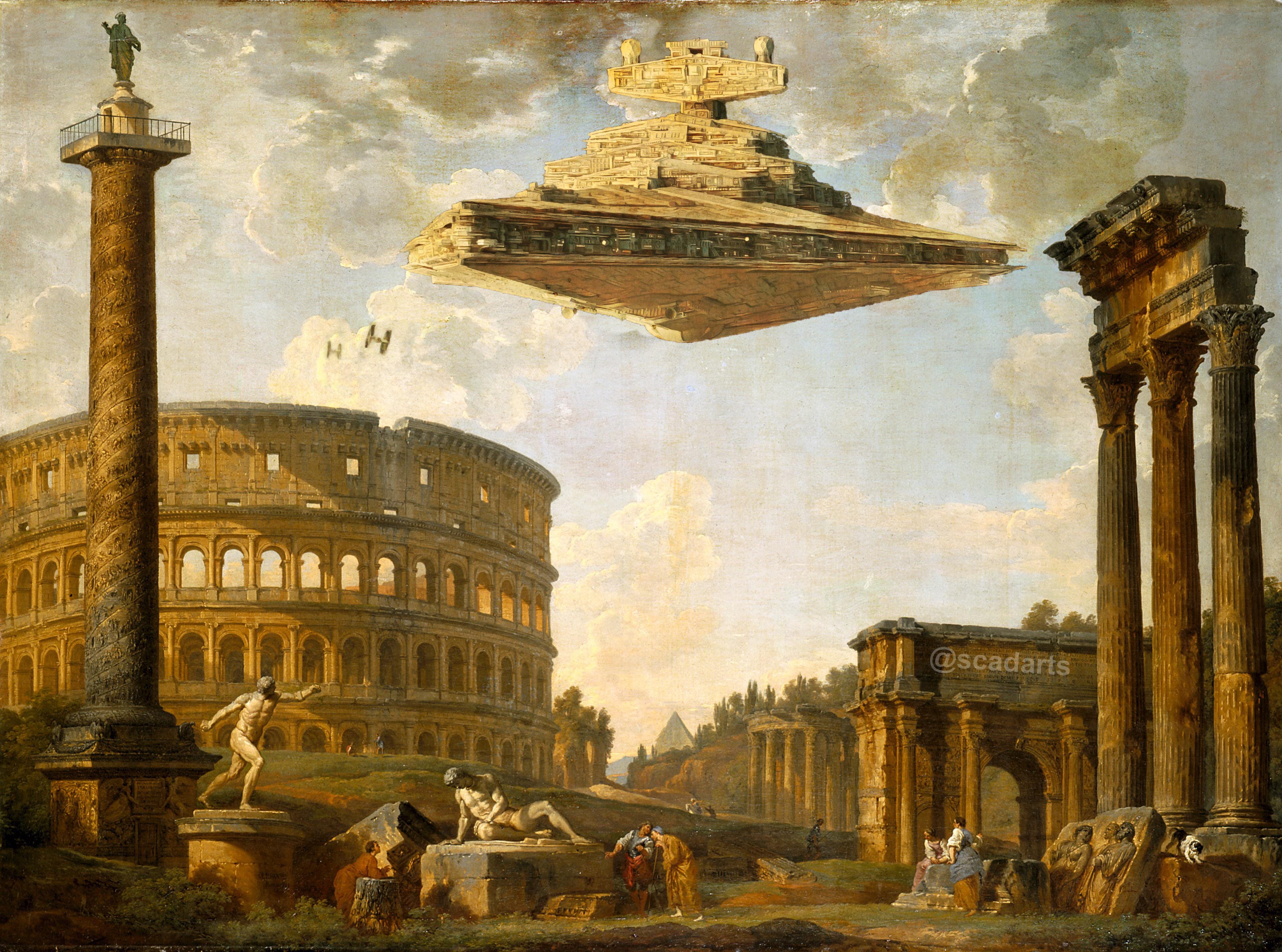
When science fiction paints the future, it doesn’t always stop at imagining new technologies or feats of engineering. Often, it will imagine new societies, new politics, new states: republics, dictatorships, technocracies, etc. Perhaps the most memorable kind of polity in science fiction however, is the empire. It isn’t hard to see why. In pages of history, it is the achievements of the empires that seem to be highlighted and underlined: from the monumental architecture of Trajan’s Rome to the overflowing riches of Mansa Musa’s Mali and the thunderous cavalry of the Khans, it is the empires that inspire the most awe and dread in us. Merriam-Webster defines empire as “a major political unit having a territory of great extent or a number of territories or peoples under a single sovereign authority,” but that hardly captures the meaning. The word “empire” connotes power, grandeur, expansion, and civilization but also oppression, decadence, conquest, and eventual collapse. No wonder then, that they feature so prominently in a genre that frequently explores all of the above.
A Tale of Two Galactic Empires
There are perhaps no two sci-fi empires more widely known than the Galactic Empire and the Galactic Empire. If there is one thing that unites the Galactic Empire of Isaac Asimov’s Foundation and that of George Lucas’ Star Wars, it’s scale. After all, isn’t it scale that makes an empire an empire and not just a dictatorship with a big ego? Both Galactic Empires are states of almost unfathomable extent that have expanded their reach across an entire galaxy, the administrative requirements of which have turned their capital planets into city worlds with oceans paved over to make room for imperial bureaucrats. Despite the shared name, though, the differences outnumber the similarities.
The Galactic Empire of Asimov’s Foundation series is a largely benevolent—or at least benign—force for order and civilization. The only real problem with it is that it’s dying. The inevitable fall of the Empire is mathematically foreseen by Hari Seldon, who establishes the titular Foundation to act as a new nucleus of technological civilization that will eventually grow into a new Galactic Empire. Asimov gives every indication that he’s right to do this. The Empire really is just about the only thing keeping technological civilization afloat prior to the foundation of the Foundation: The first worlds that slip outside of imperial control immediately lose basic scientific knowledge, which the Foundation is only able to preserve by turning science into a literal religion for the barbarous planets. The Empire isn’t even cruel or overbearing. In fact, the only repressive act we see the Empire commit in the main trilogy is to banish Hari Seldon and his followers, who predict the Empire’s doom, to the backwater planet Terminus so that their prognostications don’t send the citizenry into panic.
By contrast, the Galactic Empire of Star Wars, especially the original trilogy, is entirely malevolent. When the audience sees the technological prowess of the Empire, it is always in the form of monstrous weapons wielded against the Empire’s subjects. In fact, the Empire of the original trilogy doesn’t even appear to be a typical empire—a state with an imperial core culturally and politically dominating a provincial periphery—but rather a bleak, lifeless, military machine. The Empire’s capital, Coruscant, isn’t even shown or mentioned once in the original trilogy.1 By contrast, Trantor, the capital of Asimov’s Galactic Empire, features in all three books of the Foundation trilogy and is elaborated upon with gushing detail in the prequel novel Prelude to Foundation.
While Star Wars’ Galactic Empire has no heart, Asimov’s has no soul, at least not in the original novels. Asimov was inspired to write Foundation after reading Edward Gibbon’s Decline and Fall of the Roman Empire. The point of the Empire is to fall and decay as Rome did, therefore the Empire that Asimov gives us is essentially a sterilized version of the Roman one. It’s Rome without the slavery, gladiators, triumphs, or crucifixions, reduced to a mathematical object in one of Hari Seldon’s equations. Both the Galactic Empire of Star Wars and that of Foundation are essentially hollow vessels animated by inhuman forces.
An Empire Called Teixcalaan
In contrast to the aforementioned Galactic Empires, the Teixcalaani empire of A Memory Called Empire is an empire in the traditional sense: a distinct people with their own culture lording over the other peoples and cultures under their rule. Martine’s Teixcalaan is a neo-Aztec powerhouse whose influence is as much a product of stanzas as starships. Before her arrival at the Teixcalaani capital, the outsider protagonist Mahit Dzmare’s main experience of Teixcalaan is not one of conquest and oppression, but cultural appreciation. Mahit’s people have never felt the heel of distant Teixcalaan’s boot, but they have read its poetry and date their days by its calendar.
Much of A Memory Called Empire and its sequel A Desolation Called Peace deal with the question of identity. Mahit at once adores the art and architecture of Teixcalaan and fears it as a bored tiger that could pounce on her home and loved ones at a whim. With this comes the understanding that she can never be Teixcalaani. At best, she is a chimera who will never be fully clued into literary references that even ordinary people of the Empire would understand, but will always long to. Every glimpse of Teixcalaan’s imperial beauty, its verdant gardens of aquatic flowers, towering monuments, golden blood altars, comes with the reminder of otherness. It is a magnificent cultural inheritance, but not her inheritance. Her all-teeth barbarian smile paints her forever as an outsider.
Of the people of Mahit’s native Lsel station, some admire Teixcalaan’s art as Mahit does, others view its growing soft power wearily. Lsel’s head of Heritage fears, not unreasonably, that the empire’s culture might smother her own. In the duology, there are countless works of Teixcalaani poetry, art, and architecture described from Mahit’s perspective in minute detail, but the only piece of art or literature we see from Lsel is a comic book that Mahit buys from a teenager as a curiosity in A Desolation Called Peace. The Empire may be beautiful, but it can drown a culture without firing a shot.
Ancillary Injustice
The Radch of Ancillary Justice seems to strike a balance between the soft-power behemoth of Texicalaan and the sterile militarism of the Galactic Empires. The Radchaai Empire definitely has a distinct culture: its people consider showing their bare hands to be indecent and thus constantly wear gloves, they worship and swear by a vast, syncretic pantheon, and they produce bollywood-style musical epics for their own enjoyment. Radchaai culture colors the perspective of the protagonist, Brek, even to the point where Ancillary Justice almost exclusively uses feminine personal pronouns for its characters, since the Radchaai lack a concept of gender.
Unlike Teixcalaan, however, Radchaai culture doesn’t spread far beyond the military control of the empire, but that control is wide and it is deep. This isn’t to say that Radchaai culture isn’t powerful. It is, but as a marker of purity rather than an evangelizing force. Radchaai songs aren’t for the barbarians, they’re for the Radchaai, and they reinforce Radchaai values. The barbarians will get them eventually, once they’re “annexed.” Until then, the Radchaai are more than happy to live in blissful ignorance of other cultures, misgendering outsiders and syncretizing foreign gods with their own.
Ultimately, what unites classical-style empires like Teixcalaan and the Radch is not just a sense of imperial culture, but the willingness to place one’s own society at the center of the universe. Leckie and Martine even show this linguistically. In the Teixcalaani language, the word “empire” also means “world” and the capital planet of the Teixcalaani Empire is called “The Jewel of the World.” In the Radchaai language, the very word “Radchaai” means “civilized,” making it almost impossible to express the idea that anyone who does not call the Radch home could be civilized.
While Martine mainly shows the cultural imperialism of Teixcalaan in Memory and its capacity for military action in Desolation, Leckie does not shy away from showing the brutal, boots-on-the-ground, scorched earth imperialism of the Radch. When the Radchaai conquer a planet, the prisoners of war are either killed or have their consciousnesses erased to become “corpse-solder” ancillaries, living flesh-puppets for Radchaai warship AIs. When a delegate from a conquered planet uses a false surrender to destroy a Radchaai ship, Anaander Mianaai, the Lord of the Radch, orders the complete genocide of the planet’s people. The Radch is not a soulless killing machine like Palpatine’s Galactic Empire, but is a cultured meat grinder much better when planets burn all the same?
Government and the Nature of Empire
Many sci-fi empires have governments that would have been immediately recognizable to a historian. Both Teixcalaan and Asimov’s Galactic Empire are clearly monarchies, if imperfectly hereditary ones (hardly unusual in imperial Rome). Star Wars’ Empire is clearly something much closer to a fascist military dictatorship than a traditional empire, but that’s hardly anything unprecedented. Sometimes, though, authors and directors get creative. The Lord of the Radch, for example, is not one person but rather several thousand genetically identical clones with a linked consciousness, making her rule immortal, but also highly receptive to its citizens: it is possible for any Radchaai citizen to make an appointment to personally meet with her within a matter of weeks. While hardly democratic, the Radchaai certainly can’t complain that their government is impersonal.
The Galactic Empire of Apple TV’s Foundation adaptation gives us another example of novel imperial government enabled by advanced technology. It is ruled by the Cleon genetic dynasty, a series of clones of its founder Cleon I. There are always three Cleons: Brother Dawn, the expectant heir to the throne, Brother Day, the ruling emperor, and Brother Dusk, the former ruler and experienced advisor. Every 2-3 decades, a new Brother Dawn is “born,” the former Brother Dawn becomes the ruling Brother Day, the former Brother Day becomes the elder Brother Dusk, and the former Brother Dusk is euthanized, becoming Brother Night. This arrangement has created a remarkably stable political system for an imperial monarchy, but also results in stagnation that accelerates the fall of the Empire, according to Seldon’s math.
All of these examples feature autocratic rulers with undisputed central authority. Does an empire have to be an autocracy, though? A historian would argue that Rome was an empire long before Caesar crossed the rubicon, and that the British Empire, while nominally ruled from Buckingham Palace, was truly governed from Westminster and Downing Street. Likewise, in science fiction there are empires with no emperor. The Hegemony of Man in Dan Simmons’ Hyperion is governed by an approximately democratic republic with a bicameral legislature, yet it otherwise acts with imperial disregard for assimilated worlds. It is an empire that conquers and destroys not just with warships, but with oil drilling and tourism enabled by farcaster portals that allow its citizens to walk from one planet to another in seconds. Its culture is a bland, capitalistic farce obsessed with nostalgia for the destroyed Earth and devoid of any originality. It doesn’t destroy planets, it turns them into suburbs. Worlds like the Jewish refuge of Hebron and the oceanic once-paradise of Maui-Covenant are paved over for Hegemony corporations’ bottom line.
In a similar vein, the Expanse series by James S. A. Corey shows the oppression of the Asteroid Belt and its inhabitants (“Belters”) by the coalition of the democratically-governed United Nations and Martian Congressional Republic (collectively, “Inners”) in an obvious parallel to European colonialism in India and Africa. Inner corporations backed by powerful militaires run company-town space stations where they pay Belters pittances and gouge them for necessities. In Leviathan Wakes, the first book of the series, we are told of a group of Belters who took control of the Anderson Station from its Inner governor who was depriving them of vital oxygen. The UN’s response: to brand them as terrorists, butcher them to the last man, and give the leader of the expedition a medal of honor. Whether Earth is ruled by a monarch or governed by a secretary-general makes no difference to the Belters, empires do not tolerate provincial uprisings.
The Meaning of Empire
In science fiction, the concept of empire serves as many purposes as there are fictional empires. Some, like the Galactic Empire of Star Wars and the Romulans of Star Trek serve mainly as antagonistic forces to oppose righteous protagonists, and secondarily as stand-ins for particular ideologies, such as fascism and Cold War militarism. Others, like the Raadch and Teixcalaan serve as rich, developed, immersive settings for stories centered around ideas of identity and culture. Some, like the Hegemony of Man and the Expanse’s UN, reflect the worst imperial instincts of our own society back at us. Others still dare to imagine new forms of government and imperial administration paired with entirely new forms of oppression, repression, and planetary obliteration. In all of these civilizations, however, there is a throughline: grandiosity, the simple property of being so enormous, so advanced, so powerful that the mind can scarcely comprehend it, be it in the soft power of Teixcalaani verse, the hard power of Radchaai fleet, or the sheer magnitude of a Galactic Empire.
Perhaps that’s why empires are such a staple of a genre that swims in orders of magnitude far greater than our present; the very definition of the word implies authority over an expansive territory. At the scale of galaxies and Dyson spheres, then, what else could there be, but empire?
Aside from a 20-second scene at the end of Return of the Jedi added by Lucas to the 1997 Special Edition